

What issues should be noted when designing a COB light strip
1. Optical planning
Chip selection and placement
Select high-power or low-power LED chips based on brightness requirements, paying attention to luminous efficiency (lm/W) and color rendering index (CRI).
The density of chip placement affects light uniformity and requires optical simulation to optimize distance and prevent light and dark stripes.
Lens/Dispersion Layer Planning
COB light strips generally do not have independent lenses and require encapsulation layers (such as silicone or PC) to achieve light dispersion.
Dispersed data requires high light transmittance (> 90%) and resistance to yellowing to prevent light decay after frequent use.
Color temperature and homogeneity
The same batch of chips needs to be strictly sorted to ensure that the color temperature (such as 3000K, 4000K) and color tolerance (SDCM< 3) are consistent.
The multi-color temperature light strip needs to be planned with independent driving channels to prevent uneven color mixing.
2. Hot processing
Substrate information
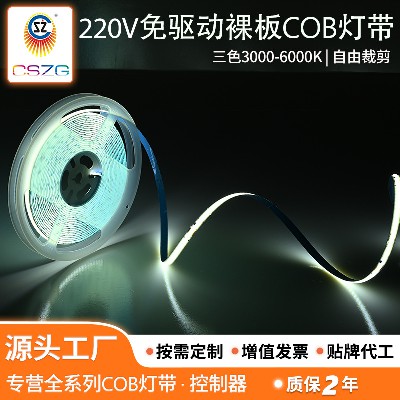
Priority should be given to using high thermal conductivity substrates (such as aluminum substrates and ceramic substrates), with a thermal conductivity coefficient of ≥ 2W/(m · K).
Avoid using low thermal conductivity materials such as FR-4 to prevent chip junction temperature from being too high (advocating junction temperature& Lt; 120 ℃).
Heat dissipation structure
Add substrate thickness or plan heat dissipation fins to increase heat capacity.
The back of the light strip can be bonded with thermal conductive adhesive or metal heat dissipation strips to enhance heat conduction with the device surface.
Thermal simulation and testing
Optimize the heat dissipation path through thermal simulation software (such as FloTHERM) to ensure that the temperature rise is within the range.
Actual testing needs to cover up high temperature environments (such as 50 ℃) and long-term lighting scenarios.
3. Electrical planning
Drive Plan
Constant current drive is crucial to prevent voltage fluctuations from causing current instability (such as using linear constant current ICs or switching power supplies).
Multi series parallel planning requires balancing the currents of each branch to prevent partial overload.
Voltage and power matching
Calculate the total current based on the length and power of the light strip, and select the appropriate wire diameter (such as a 0.5mm ² copper wire carrying approximately 3A current).
The input voltage should be matched with the driving power supply (such as 12V/24V DC) to prevent high voltage hazards.
Article source: Zhongshan COB LED strip manufacturer www.citylightcob.com
-
01-22
What issues should be noted when transporting COB light strips
1、 Packaging protection: multi-layer cushioning and fixationInner layer protectionWrap the entire lamp strip with bubble wrap, with a focus on protecting the two end interfaces and chip area (vulnerab
-
01-21
What issues should be noted when designing a COB light strip
1. Optical planningChip selection and placementSelect high-power or low-power LED chips based on brightness requirements, paying attention to luminous efficiency (lm/W) and color rendering index (CRI)
-
01-19
What are the types of COB lamps
1、 Classified by voltageLow voltage COB light stripVoltage: 12V, 24V (common), 5V, 48V (rare).Features:High protection: Low voltage with no risk of electric shock, suitable for close range touch scena
-
01-16
How to choose a suitable COB light strip
1、 Bottom plate quality: determines the lifespan of the LED stripDouble sided electroplated board: Copper content ≥ 2.5, fast heat dissipation, strong conductivity, suitable for long-term use (such as